Learning to bad vs too bad becomes easier when you focus on meaning, grammar, common usage patterns, and everyday English examples clearly.
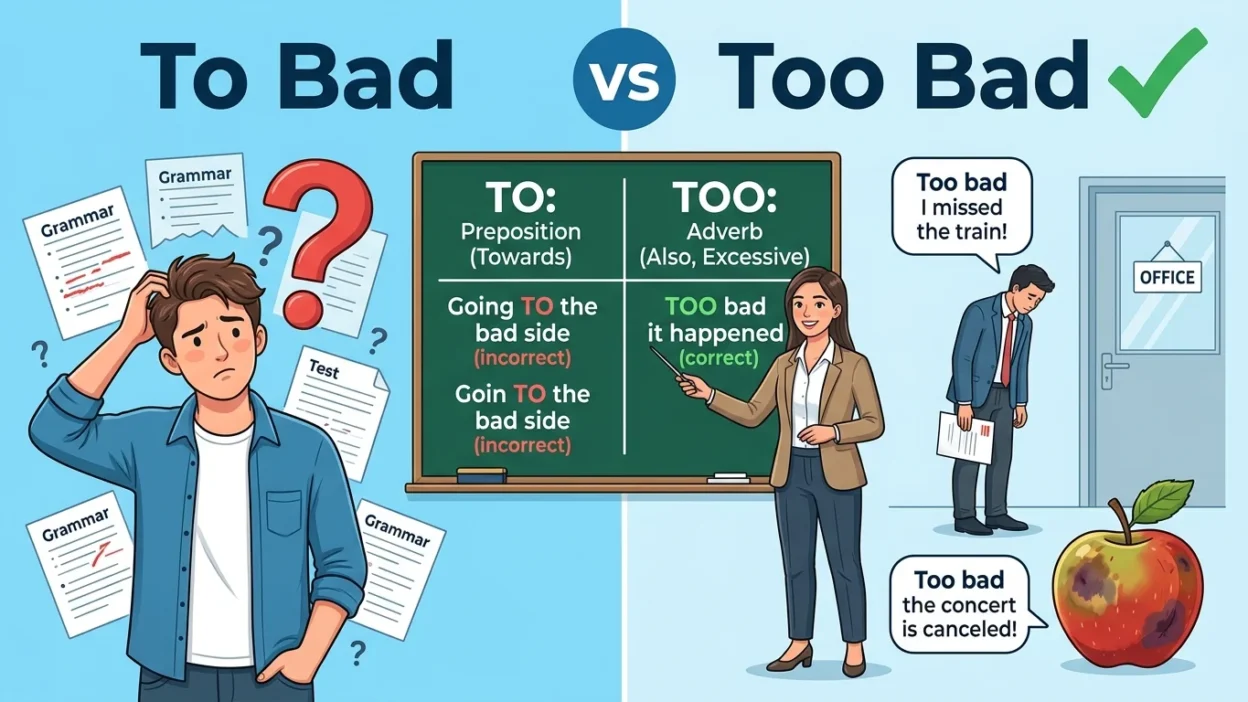
The expression too bad is the most common form used when something is unfortunate. It means something overly or extremely disappointing. For example, if someone did not get the job they wanted, you might say “too bad” and offer hope for next time. From my experience, this phrase is the one most people use naturally in everyday English.
The phrase can also describe something that is no longer useful. If a rotten part of a fruit makes it impossible to keep, you may throw it into the garbage. For instance, an apple may be too bad and you could not use it anymore. This usage helps explain when something becomes excessively damaged or spoiled.
The word to is a preposition and is rarely paired with bad in this way. Instead, bad often works as an adjective describing a noun or the object of a sentence. You may see examples where good things happen to bad people, which follows a different grammatical pattern.
Quick Answer
Simple Rule
| If You Mean… | Use |
| Something unfortunate or disappointing | Too Bad |
| The word “to” before “bad” in a sentence | To Bad |
Quick Facts
| Question | Answer |
| Is “too bad” correct? | Yes |
| Is “to bad” usually used alone? | No |
| Which expression is more common? | Too Bad |
| Does “too” mean excessively? | Yes |
| Can “bad” describe a noun? | Yes |
| Is “too bad” common in conversation? | Very common |
Simple Background Explanation
English contains many words that sound alike but have different meanings.
The confusion comes from the words to and too.
| Word | Meaning |
| To | Shows direction, movement, or relationship |
| Too | Means excessively, very, or also |
Because the words sound almost the same, many people accidentally write to bad when they really mean too bad.
What Does “Too Bad” Mean?
The phrase too bad is used when something is unfortunate, disappointing, or not good.
Examples
| Sentence | Meaning |
| Too bad you missed the concert. | An unfortunate situation |
| Too bad the store was closed. | Something disappointing happened |
| Too bad the weather changed. | An unfortunate event occurred |
| Too bad you could not come. | Expressing sympathy |
Why It Works
In this phrase, too means:
- Excessively
- Very
- Extremely
So too bad means something is very bad or unfortunate.
What Does “To Bad” Mean?
The combination to bad is not usually a fixed phrase.
Instead, it appears when to functions as a preposition and bad describes a noun or person.
Examples
| Sentence | Explanation |
| Why do good things happen to bad people? | “To” connects to “people” |
| The prize went to bad teams last year. | “Bad” describes teams |
| The teacher spoke to bad students about behavior. | “Bad” describes students |
Notice that to bad is simply part of a larger sentence.
The Main Difference
| Feature | Too Bad | To Bad |
| Type | Common phrase | Part of a sentence |
| Meaning | Unfortunate or disappointing | To + bad noun/person |
| Common in conversation | Yes | No |
| Common in writing | Yes | Sometimes |
| Complete expression | Yes | Usually no |
| Easy to recognize | Yes | Depends on context |
The biggest difference is simple:
- Too bad expresses disappointment.
- To bad is usually just a grammatical combination inside a sentence.
Comparison Table
| Feature | Too Bad | To Bad |
| Correct phrase? | Yes | Not usually |
| Express sympathy? | Yes | No |
| Shows disappointment? | Yes | No |
| Uses the word “too”? | Yes | No |
| Uses the preposition “to”? | No | Yes |
| Common in daily speech? | Very common | Rare |
| Used in emails? | Often | Rarely |
| Used in social media? | Often | Rarely |
| Used in school writing? | Sometimes | Depends on sentence |
| Easy for beginners? | Yes | Can be confusing |
Which One Should You Use and When?
Use “Too Bad” When:
| Situation | Example |
| Showing sympathy | Too bad you missed the event. |
| Expressing disappointment | Too bad the game was canceled. |
| Talking about an unfortunate situation | Too bad it rained all day. |
| Casual conversations | Too bad we arrived late. |
Use “To Bad” When:
| Situation | Example |
| “To” links with a noun | Good things happen to bad people. |
| “Bad” describes someone | She spoke to bad students. |
| “Bad” describes a group | Awards went to bad teams. |
Common Mistakes People Make
Mistake 1
❌ To bad you missed the movie.
✅ Too bad you missed the movie.
Why?
You are expressing disappointment.
Mistake 2
❌ Too bad people sometimes succeed.
✅ Good things happen to bad people.
Why?
You are using “to” as a preposition.
Mistake 3
❌ The teacher talked too bad students.
✅ The teacher talked to bad students.
Why?
The sentence needs the preposition “to.”
Mistake 4
❌ Too bad people always lose.
✅ Bad people do not always lose.
Why?
The phrase “too bad” does not fit the sentence’s meaning.
Everyday Real-Life Examples
In Emails
| Example |
| Too bad the meeting was postponed. |
| The manager spoke to bad employees about attendance. |
In News Reports
| Example |
| Too bad the event was canceled because of the weather. |
| Aid was given to bad areas affected by flooding. |
On Social Media
| Example |
| Too bad I missed the concert. |
| Good things happen to bad people sometimes. |
At School
| Example |
| Too bad you forgot your homework. |
| The teacher talked to bad students after class. |
Daily Conversation
| Example |
| Too bad the restaurant was closed. |
| Why do good things happen to bad people? |
Learning Section for Students and Beginners
A simple memory trick can help.
| Word | Memory Tip |
| Too | Think “too much” |
| To | Think direction or connection |
Quick Practice
| Sentence | Answer |
| _____ bad you missed the bus. | Too |
| Good things happen _____ bad people. | To |
| _____ bad the game ended early. | Too |
| She spoke _____ bad students. | To |
Easy Rule to Remember
| Meaning | Correct Choice |
| Unfortunate situation | Too Bad |
| Direction or connection | To Bad |
FAQ
1. Is “too bad” correct English?
Yes. It is a very common and correct expression.
2. Is “to bad” wrong?
Not always. It can appear inside a larger sentence.
3. Which one is more common?
Too bad is much more common.
4. What does “too bad” mean?
It means something unfortunate or disappointing happened.
5. Why do people confuse them?
Because to and too sound very similar.
6. Can I use “too bad” in formal writing?
Yes, although it is more common in conversation.
7. Does “too” mean very?
Yes. It often means excessively or extremely.
8. How can I remember the difference?
Remember that too has an extra “o.” Think of it as “extra” or “too much.”
Conclusion
Uhttps://www.merriam-webster.com/dictionary/expressionnderstanding to bad vs too bad is much easier once you know the role of each word. Too bad is a common phrase used to express disappointment, sympathy, or an unfortunate situation. It is the expression most people use in everyday English.
To bad, however, is usually not a phrase on its own. Instead, it appears when the preposition to is connected to a noun that bad describes.
Whenever you want to say something is unfortunate, choose too bad. Whenever to connect with a noun or person being described as bad, use to bad as part of the sentence. With a little practice, the difference will become natural and easy to remember.