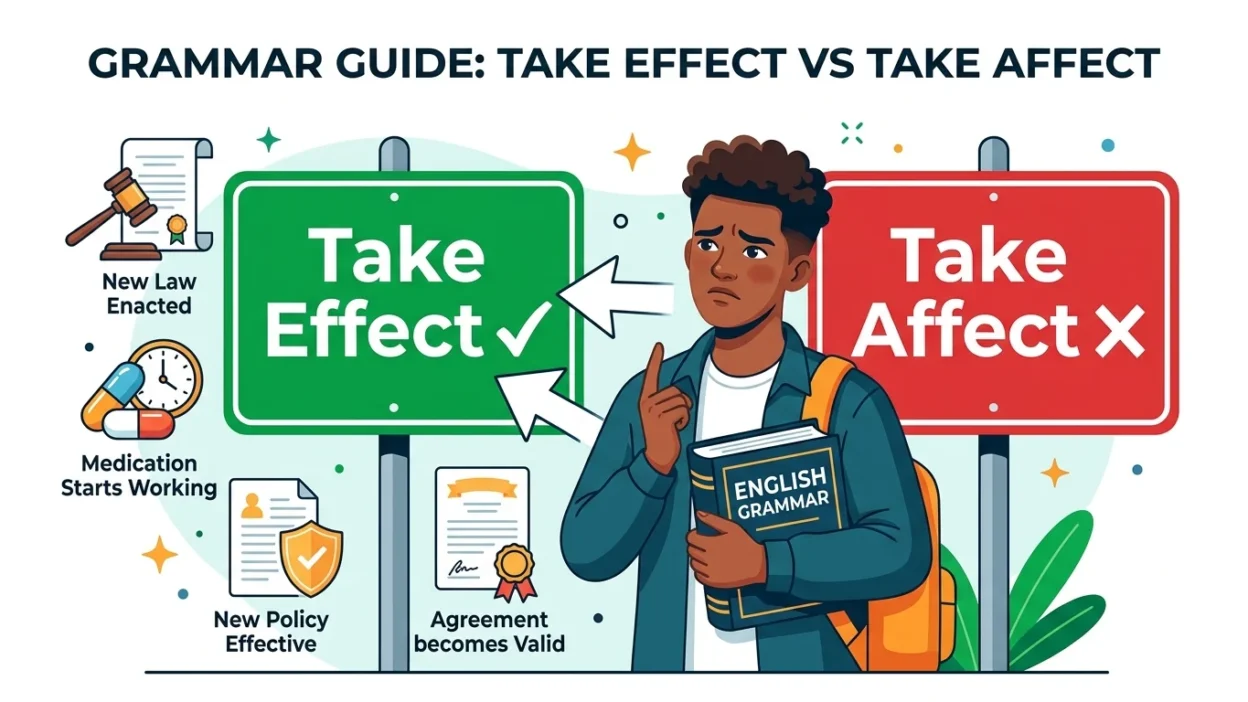
Learning take effect vs take affect becomes simple when you stop overthinking Affect or Effect? and focus on how learners get confused between verbs and nouns that sometimes overlap in meanings, especially in English for first language speakers. A basic guideline helps to clarify how to use words correctly in real communication. From my experience, this rule makes it easier to understand how affect verbs and effect nouns work in daily writing.
The general rule is that affect means to act on or produce change, like when cold weather affects crops, or music deeply affects feelings and thoughts, or even when it can impress the mind and move feelings. If you substitute a verb, you will see how damaged crop shows clear action, and something that moved him emotionally helps you express change, describe action, and always choose affect when talking about action.
In contrast, an effect noun refers to result, consequence, or outcome. For example, sunburn from exposure to the sun shows a clear result meaning, and you can replace nouns to understand it better. This gives you correct use, where guideline, difference, and word type (verb, noun) matter, and simple example sentences help make the idea of effect nouns very clear.
Quick Answer
- Take effect = something starts working or becomes active
- Take affect = not a correct common phrase in standard English
- “Effect” is a noun → result or change
- “Affect” is a verb → to influence something
- Most of the time, only take effect is used in real English
- Example: The new law will take effect tomorrow
Simple Background Explanation
English has many words that look similar but have different jobs in a sentence.
The confusion comes from two words:
- Effect → usually a noun (result)
- Affect → usually a verb (to change something)
So when we say “take effect,” we are talking about something that starts to work or becomes active.
The phrase “take affect” is rarely used and is usually considered incorrect in normal English writing or speaking.
What Does “Take Effect” Mean?
Take effect means something begins to work, start, or become active.
It is very common in:
- Laws
- Rules
- Medicines
- Policies
- Agreements
Examples:
- The new rule will take effect next month.
- The medicine will take effect in 30 minutes.
- The policy takes effect from today.
- The changes will take effect immediately.
Simple idea:
Something is “sleeping” → then it starts working → that is take effect
Why “Take Affect” Is Confusing
Many learners try to use take affect, but it is not standard English in most cases.
This is because:
- “Affect” is a verb (to influence)
- “Take” usually needs a noun after it in this phrase
- So “take effect” fits naturally, but “take affect” does not
Example of confusion:
❌ The law will take affect tomorrow.
✔ The law will take effect tomorrow.
Comparison Table
| Feature | Take Effect | Take Affect |
| Correct usage | Yes | No (rare/incorrect) |
| Meaning | Something starts working | Not a standard phrase |
| Grammar type | Verb + noun phrase | Incorrect combination |
| Common in laws | Yes | No |
| Common in medicine | Yes | No |
| Used in writing | Very common | Avoid |
| Used in speech | Very common | Not natural |
Which One to Use and When?
Use “Take Effect” when:
- Talking about laws or rules
- The law will take effect next year
- Talking about medicine
- The painkiller takes effect quickly
- Talking about changes
- The new system will take effect soon
- Talking about official decisions
- The policy takes effect today
Avoid “Take Affect” because:
- It is not standard English
- It sounds unnatural in most sentences
- Native speakers usually do not use it
Common Mistakes People Make
Mistake 1:
❌ The rule will take affect tomorrow
✔ The rule will take effect tomorrow
Mistake 2:
❌ The medicine will take affect soon
✔ The medicine will take effect soon
Mistake 3:
❌ New changes take affect today
✔ New changes take effect today
Why this happens:
People mix up affect and effect because they sound similar.
Everyday Real-Life Examples
In News:
- The new tax law will take effect next year
- The regulation takes effect immediately
At Work:
- The new schedule takes effect from Monday
- Changes will take effect after approval
At School:
- The new rule takes effect this term
- Attendance policy takes effect today
In Daily Life:
- The medicine takes effect in 20 minutes
- The changes take effect slowly
Learning Section for Students
Easy Trick to Remember:
- Effect = End result (something starts working)
- Affect = Action (to influence)
Simple Memory Rule:
👉 “When something STARTS working → use take effect”
Practice:
Fill in the blanks:
- The law will ____ ____ tomorrow.
- The medicine will ____ ____ soon.
- The new rule takes ____ today.
Answers:
- take effect
- take effect
- effect
FAQ
1. Is “take effect” correct English?
Yes, it is the correct and most common phrase.
2. Is “take affect” wrong?
Yes, in most cases it is not correct English.
3. What does “take effect” mean?
It means something starts working or becomes active.
4. Can I use “take affect” in writing?
It is not recommended.
5. Why do people confuse them?
Because “effect” and “affect” look and sound similar.
6. Is “effect” a verb or noun?
Usually a noun.
7. Is “affect” a verb or noun?
Usually a verb.
8. Where is “take effect” used most?
In laws, rules, medicine, and official changes.
Conclusion
The difference between take effect vs take affect is actually very simple once you understand the meaning.
- Take effect means something begins to work or become active
- Take affect is not normally correct in English
If you remember just one rule, remember this:
👉 When something starts working, always use take effect
With practice, you will naturally stop mixing them and use the correct phrase in everyday English.