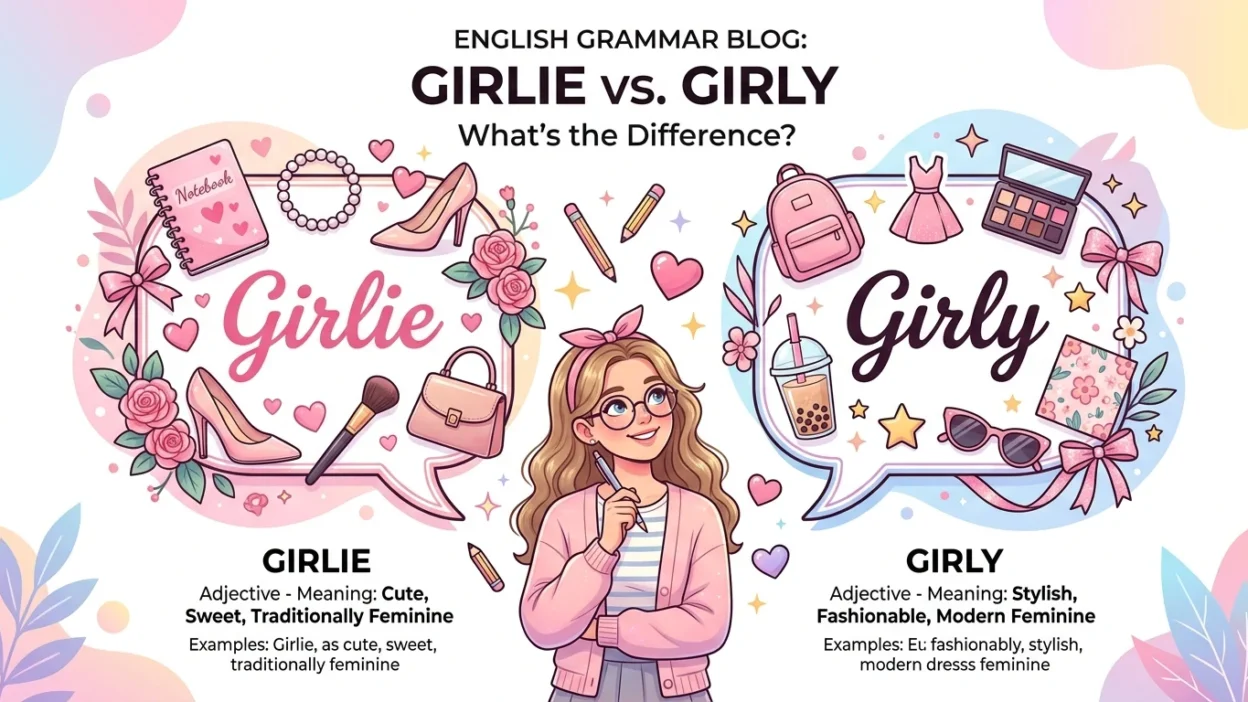
The topic of girlie vs girly often creates confusion because these words have nearly identical appearances but carry distinct meanings and applications in the English language, making them one of the more unique challenges for learners and even native speakers. From my experience, the terms girlie and girly exemplify linguistic complexity because both relate to feminine characteristics, yet their usage, patterns, connotations, and grammatical functions can differ significantly depending on the situation. Paying attention to context helps readers understand these important distinctions more easily.
When discussing these expressions, the impact of word choice matters in professional communication, casual conversation, and written expression. A clear understanding can prevent confusion, avoid misusing language, and help explain how small variations may alter an intended message, affect credibility in different settings, or create misunderstandings in cross-cultural environments. In my view, knowing these differences between the expressions is often more crucial than many people expect.
Many native speakers intuitively navigate these language choices, while learners sometimes struggle with subtle meanings. Through careful interpretation, strong vocabulary, and awareness of appropriate usage, it becomes easier to determine which term fits a particular appearance or circumstance. By studying these language matters in everyday situations, readers gain greater confidence and a better understanding of how girlie and girly function in modern English.
Quick Answer
| Question | Answer |
| Is “girly” a real word? | Yes |
| Is “girlie” a real word? | Yes |
| Which is more common? | Girly |
| Which sounds more casual? | Girlie |
| Can both describe feminine interests? | Yes |
| Is one incorrect? | No |
| Best choice for most writing? | Girly |
| Common in everyday speech? | Both |
Simple Rule
- Girly is the more common spelling.
- Girlie often sounds more playful or informal.
- Both relate to feminine styles, interests, or characteristics.
- In formal writing, girly is usually preferred.
Background and Origin
English has many words that end with -y or -ie.
Examples include:
| -Y Form | -IE Form |
| Doggy | Doggie |
| Birdy | Birdie |
| Girly | Girlie |
Over time, people began using both endings to create friendly or affectionate versions of words.
The word girly developed as an adjective that describes something associated with girls or traditional feminine qualities.
The word girlie later became a more playful variation. It is often used as a nickname, friendly label, or casual description.
That is why both words exist today.
Understanding the Difference
What Does “Girly” Mean?
Girly is usually an adjective.
It describes:
- Fashion
- Colors
- Activities
- Personality traits
- Styles associated with girls or femininity
Examples:
- She likes girly clothes.
- The room has a girly design.
- Her style is very girly.
What Does “Girlie” Mean?
Girlie is often used as a noun or informal nickname.
Examples:
- Hey girlie, how are you?
- She is a girlie who loves fashion.
- The group called themselves the girlies.
It can also describe something feminine, but it often feels more personal and conversational.
Comparison Table
| Feature | Girly | Girlie |
| Real English word | Yes | Yes |
| More common | Yes | No |
| Formal writing | Better choice | Less common |
| Informal conversation | Yes | Yes |
| Used as adjective | Mostly | Sometimes |
| Used as nickname | Rarely | Often |
| Describes feminine style | Yes | Yes |
| Used on social media | Very common | Common |
| Sounds playful | Sometimes | Usually |
| Used in professional writing | More acceptable | Less common |
Which One Should You Use and When?
Use “Girly” When:
| Situation | Example |
| Describing fashion | Girly dresses |
| Describing colors | Girly pink shades |
| Describing style | Girly decorations |
| Writing articles | Girly trends |
| Formal communication | Girly appearance |
Use “Girlie” When:
| Situation | Example |
| Friendly nickname | Hey girlie |
| Casual texting | Thanks, girlie |
| Social media captions | Best girlie ever |
| Informal conversations | My girlie loves shopping |
Easy Memory Trick
Think of it this way:
Girly = Description
Girlie = Person or nickname
This simple trick helps many learners remember the difference.
Common Mistakes People Make
Mistake 1
Using girlie in formal writing.
❌ The company launched a girlie clothing collection.
✔ The company launched a girly clothing collection.
Mistake 2
Thinking one spelling is wrong.
❌ Girlie is incorrect.
✔ Both words are correct.
Mistake 3
Using them without considering tone.
A sentence can sound much more casual when you choose girlie.
Mistake 4
Assuming both always mean exactly the same thing.
While they are similar, they can create slightly different impressions.
Everyday Real-Life Examples
Emails
Formal:
- The brand focuses on girly fashion trends.
Informal:
- Thanks for helping me, girlie.
Social Media Posts
- Loving my girly outfit today.
- Coffee date with my favorite girlie.
Daily Conversation
- Her room has a girly theme.
- That girlie always makes me laugh.
Fashion Discussions
- Girly dresses are popular this season.
- Many influencers share girly outfit ideas.
Text Messages
- Hi girlie, what are you doing?
- That outfit looks super girly.
Learning Section for Students
Quick Practice
Choose the correct word.
- She likes very _____ clothes.
- Thanks for the gift, _____.
- The room has a _____ style.
- My best _____ called me today.
- The magazine discusses _____ fashion.
Answers
| Question | Correct Answer |
| 1 | Girly |
| 2 | Girlie |
| 3 | Girly |
| 4 | Girlie |
| 5 | Girly |
Student Tip
If you are describing something, choose girly.
If you are talking directly to a person in a friendly way, girlie may work better.
FAQs
1. Is girlie a real word?
Yes. It is a real English word.
2. Is girly a real word?
Yes. It is very common in modern English.
3. Which spelling is more common?
Girly is generally more common.
4. Can I use girlie in formal writing?
You can, but girly is usually the safer choice.
5. Do they mean the same thing?
They have similar meanings but different tones.
6. Which one sounds more playful?
Girlie usually sounds more playful and friendly.
7. Which one should learners use?
Girly is often the easiest and safest choice.
8. Are both accepted in modern English?
Yes. Both are accepted and understood.
Conclusion
The difference between girlie vs girly is not difficult once you understand how each word is used.
Girly is the more common option and is usually used to describe feminine styles, interests, or characteristics. Girlie is often more casual and friendly, especially when used as a nickname or informal term.
The good news is that both words are correct English. The best choice depends on your audience and the tone you want to create. With a little practice, you will quickly know which word fits your sentence and use both with confidence.