The topic of goodmorning vs good morning often creates confusion for learners because a simple greeting can look correct in more than one way during writing. Many people have paused while typing a mid-text message or email, wondering which form is correct, and this small difference can affect a first impression in both personal and professional communication.
From my experience teaching English grammar, understanding proper usage really matters, especially when sending a business greeting, starting a casual chat, or creating social media captions. The correct and accepted greeting, good morning, follows standard grammar rules, helps your writing sound natural, and makes messages look more polished and professional in different situations.
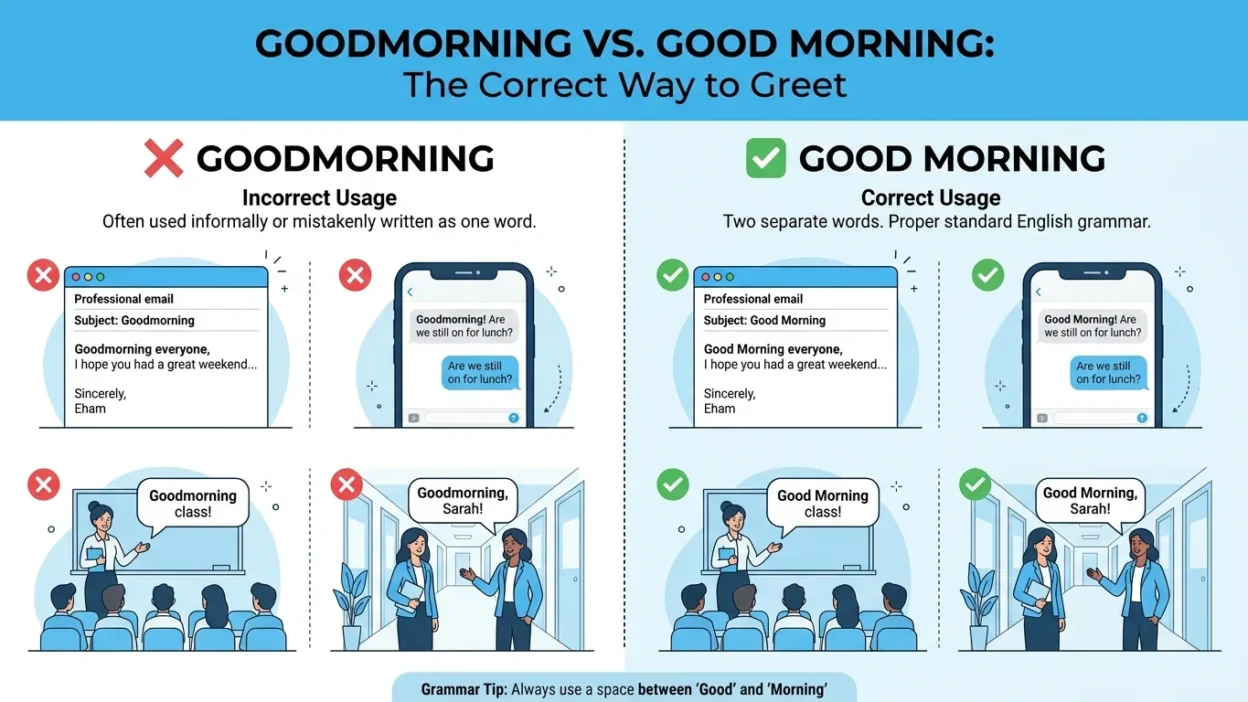
The spelling goodmorning is often treated as a mistake in formal writing, while good morning remains the preferred choice in everyday communication. Knowing this rule removes confusion, making it easier to choose the right greeting when writing messages, emails, posts, or friendly greetings.
Quick Answer
| Question | Answer |
| Is “good morning” correct? | Yes |
| Is “goodmorning” correct? | Usually no |
| Which form should I use in emails? | Good morning |
| Which form is used in formal writing? | Good morning |
| Which form is accepted in standard English? | Good morning |
| Which form should learners remember? | Good morning |
Simple Rule
- ✅ Good morning = Correct
- ❌ Goodmorning = Usually incorrect
- ✅ Use “good morning” as a greeting
- ✅ Use it in emails, letters, messages, and conversations
- ❌ Avoid “goodmorning” in formal writing
Simple Background Explanation
The phrase good morning comes from two separate words:
- Good = positive or pleasant
- Morning = the first part of the day
When combined, they form a greeting.
Examples:
- Good morning, everyone.
- Good morning, Sarah.
- Good morning, class.
In standard English, these words stay separate.
Over time, many people started typing goodmorning as one word in text messages and online conversations. However, standard grammar still prefers good morning with a space.
Understanding the Difference
The biggest difference is spelling.
| Feature | Good Morning | Goodmorning |
| Two separate words | Yes | No |
| Standard English | Yes | No |
| Formal writing | Yes | No |
| Business emails | Yes | No |
| School assignments | Yes | No |
| Common greeting | Yes | Rare |
| Dictionary form | Yes | No |
| Recommended usage | Yes | No |
Think of it this way:
Good morning works like:
- Good afternoon
- Good evening
- Good night
All of these greetings use separate words.
Because of that pattern, good morning also stays as two words.
Comparison Table
Detailed Comparison
| Category | Good Morning | Goodmorning |
| Correct spelling | Yes | No |
| Grammar approved | Yes | No |
| Used by teachers | Yes | No |
| Used in professional writing | Yes | No |
| Used in business communication | Yes | No |
| Used in academic writing | Yes | No |
| Seen in casual texting | Sometimes | Yes |
| Recommended for learners | Yes | No |
| Appears in formal greetings | Yes | No |
| Best choice for daily writing | Yes | No |
Which One to Use and When?
Always use good morning when greeting someone.
In Emails
✅ Good morning, Mr. Ahmed.
❌ Goodmorning, Mr. Ahmed.
In School
✅ Good morning, teacher.
❌ Goodmorning, teacher.
At Work
✅ Good morning, team.
❌ Goodmorning, team.
In Messages
✅ Good morning! How are you today?
❌ Goodmorning! How are you today?
On Social Media
✅ Good morning, everyone!
❌ Goodmorning, everyone!
The correct form stays the same in almost every situation.
Common Mistakes People Make
1: Combining the Words
Many people write:
❌ Goodmorning
Correct:
✅ Good morning
2: Copying Informal Internet Usage
Some online posts use:
❌ Goodmorning friends
Standard English:
✅ Good morning, friends
3: Using It in Professional Emails
Incorrect:
❌ Goodmorning Sir,
Correct:
✅ Good morning, Sir,
4: Thinking Both Forms Are Equal
Some learners believe both spellings are accepted.
Actually:
- Good morning = standard English
- Goodmorning = generally considered a spelling error
Everyday Real-Life Examples
Email Examples
✅ Good morning, I hope you are well.
✅ Good morning, thank you for your message.
News Examples
✅ Good morning and welcome to today’s program.
✅ Good morning, viewers.
Social Media Examples
✅ Good morning, everyone! Have a wonderful day.
✅ Good morning from the beach.
Daily Conversation Examples
Person A: Good morning!
Person B: Good morning! How are you?
Workplace Examples
Manager: Good morning, team.
Employee: Good morning.
School Examples
Teacher: Good morning, class.
Students: Good morning, teacher.
Learning Section for Students
Easy Memory Trick
Remember:
👉 Good + Morning = Two words
Think about these greetings:
- Good afternoon
- Good evening
- Good night
They all have spaces.
So:
✅ Good morning
Quick Practice
Choose the correct answer.
- _____ everyone.
- _____ teacher.
- _____ and welcome.
- _____ team.
- _____ class.
Answers
- Good morning
- Good morning
- Good morning
- Good morning
- Good morning
FAQs
1. Is “good morning” correct?
Yes. It is the standard and correct form.
2. Is “goodmorning” a real word?
It is sometimes seen online, but it is not the standard spelling.
3. Which form should I use in emails?
Always use good morning.
4. Can I use “goodmorning” in professional writing?
No. Use good morning instead.
5. Why do people write “goodmorning”?
Many people type quickly in texts and social media posts.
6. Is “good morning” formal or informal?
It can be both. It works in professional and casual situations.
7. Do native speakers use “good morning”?
Yes. It is the normal and accepted greeting.
8. What is the easiest rule to remember?
If you are greeting someone, write:
✅ Good morning
Conclusion
The difference between goodmorning vs good morning is very simple once you know the rule.
Good morning is the correct spelling in standard English. It is used in emails, schools, workplaces, conversations, and formal writing.
Goodmorning is commonly seen in informal typing, but it is not the recommended form for correct English writing.
If you remember one thing, remember this:
👉 Always write good morning as two separate words.
Following this simple rule will help you write more clearly, communicate professionally, and avoid a very common spelling mistake.