The topic of afterward vs afterwards becomes easier to understand when you focus on usage, context, and meaning rather than memorizing rules alone daily. Many people feel confused by similar spellings and pronunciations because afterward and afterwards serve slightly different functions in writing and speech. During my English-speaking journey, I learned that time matters when a word appears later than a point already mentioned, indicating subsequent events, a part of a period, or a sequence in communication. This approach makes understanding the difference much easier because it encourages a focus on context instead of memorizing rules.
Another useful point involves afterword, a specific section at the end of a book, often written by someone other than the main author, offering insights, comments, and explanations about the text. This distinction shows why these words are correct in both North American and British usage, although preferences vary. Many writers in the U.S. and Canada tend to favor afterward, while English speakers from outside those regions often lean toward afterwards. It is not a strict rule, and exceptions are easily found.
A key tip for the topic is to break it into examples. Every word ending in ward often has a parallel wards form that may be interchangeable in some contexts, though few are truly undifferentiated. In modern English, forward and forwards sometimes overlap, but subtle differences lie in how they are used. Walking through real-life situations helps you grasp how sentences can shine. Over time, I figured that knowing these small nuances can introduce a twist that surprises readers. Depending on your audience, feeling safe while speaking, coaching, or improving fluency allows you to use either form correctly, changing meaning without losing clarity.
Quick Answer
| Question | Answer |
| Is afterward correct? | Yes |
| Is afterwards correct? | Yes |
| Do they mean the same thing? | Yes |
| Is afterward American English? | Usually yes |
| Is afterwards British English? | Usually yes |
| Can both be used in writing? | Yes |
| Can both be used in speech? | Yes |
| Is one more formal? | No |
| Should you mix them in one document? | No |
| Do they change sentence meaning? | Usually no |
Key Points
- Both spellings are correct.
- Both mean “later” or “at a later time.”
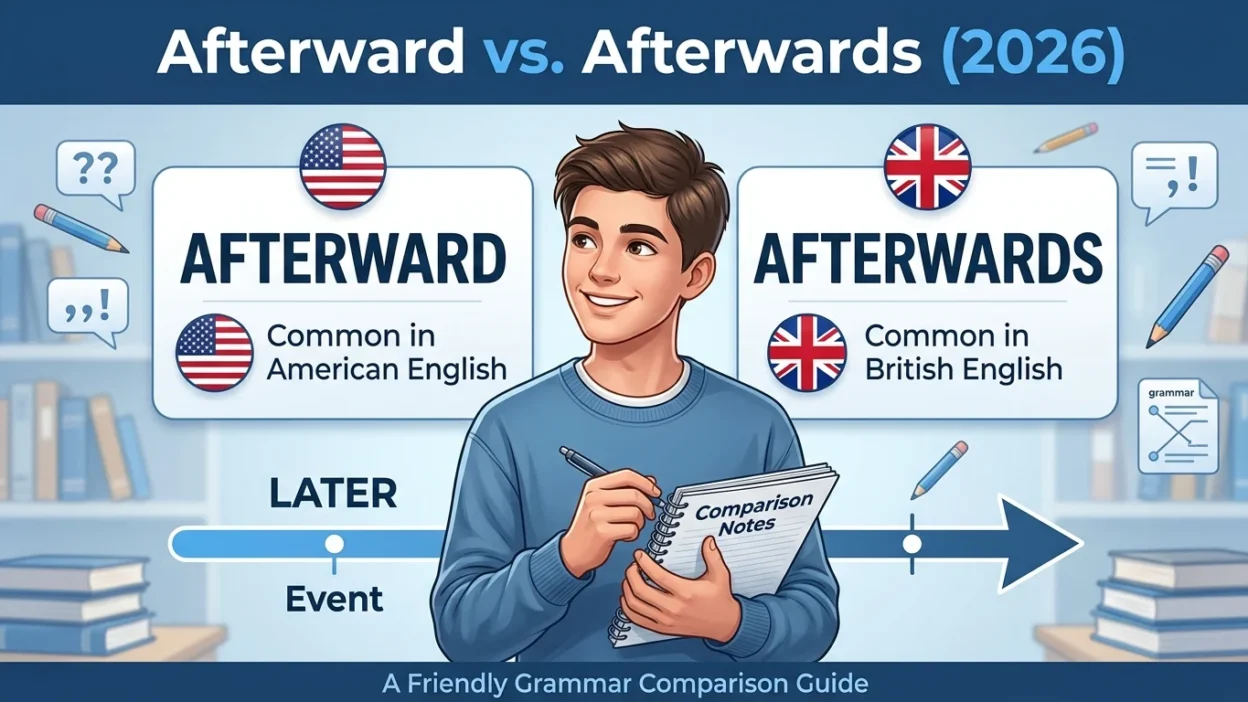
- American English usually prefers afterward.
- British English often prefers afterwards.
- The meaning stays the same.
Simple Background Explanation
English has changed over many years.
Some words developed two accepted spellings. One spelling became more common in North America, while another became more common in Britain and some other English-speaking countries.
A common pattern involves words ending in -ward and -wards.
| American Style | British Style |
| afterward | afterwards |
| forward | forwards |
| toward | towards |
| backward | backwards |
Because of this pattern, both forms survived and are still used today.
What Does Afterward Mean?
Afterward means later, after something happens, or at a later time.
Examples
| Sentence |
| We went home afterward. |
| She finished her homework and afterward watched TV. |
| The meeting ended and afterward everyone left. |
| He called me afterward to explain. |
In each example, the action happens later than something mentioned before.
What Does Afterwards Mean?
Afterwards has the same meaning as afterward.
It also means later or at a later time.
Examples
| Sentence |
| We went home afterwards. |
| She finished her homework and afterwards watched TV. |
| The meeting ended and afterwards everyone left. |
| He called me afterwards to explain. |
The meaning is exactly the same.
Afterward vs Afterwards: Main Difference
| Feature | Afterward | Afterwards |
| Meaning | Later | Later |
| Correct spelling | Yes | Yes |
| American English | Preferred | Less common |
| British English | Less common | Preferred |
| Pronunciation | Same | Same |
| Grammar | Same | Same |
| Formal writing | Accepted | Accepted |
| Informal writing | Accepted | Accepted |
| Spoken English | Common | Common |
| Meaning change | No | No |
The biggest difference is regional preference, not meaning.
Which One to Use and When?
Use Afterward When
| Situation | Example |
| Writing in American English | We talked afterward. |
| Writing for U.S. readers | He apologized afterward. |
| Following American style guides | She left afterward. |
Use Afterwards When
| Situation | Example |
| Writing in British English | We talked afterwards. |
| Writing for British readers | He apologized afterwards. |
| Following British spelling style | She left afterwards. |
Easy Rule
If you are unsure, either word is usually fine.
Just stay consistent throughout your writing.
Common Mistakes People Make
1: Thinking One Is Wrong
❌ Afterwards is incorrect.
✔ Afterwards is a correct English word.
2: Thinking They Have Different Meanings
❌ Afterward means something different from afterwards.
✔ Both words have the same meaning.
3: Mixing Styles
❌ We met afterward and talked afterwards.
✔ We met afterward and talked afterward.
OR
✔ We met afterwards and talked afterwards.
4: Confusing Afterward with Afterword
| Word | Meaning |
| Afterward | Later |
| Afterwards | Later |
| Afterword | A section at the end of a book |
Example:
❌ I read the afterward of the book.
✔ I read the afterword of the book.
Everyday Real-Life Examples
In Emails
| Example |
| I will send the report afterward. |
| Let’s discuss it afterwards. |
| We can talk afterward if needed. |
In News Writing
| Example |
| The event ended and afterward people returned home. |
| The announcement was made and afterwards reactions appeared online. |
On Social Media
| Example |
| Went shopping and afterward grabbed coffee. |
| Finished the workout and afterwards felt great. |
In Daily Conversation
| Example |
| Let’s eat and afterward watch a movie. |
| We can talk afterwards. |
| He arrived afterwards and joined the group. |
Learning Section for Students
Easy Memory Trick
Remember:
| Word | Meaning |
| Afterward | Later |
| Afterwards | Later |
The extra s does not change the meaning.
Practice Exercise
Fill in the blanks.
- We went home ______.
- She called me ______.
- The game ended and ______ we ate dinner.
Answers
| Question | Answer |
| 1 | afterward / afterwards |
| 2 | afterward / afterwards |
| 3 | afterward / afterwards |
Both answers are correct depending on the style you are using.
FAQs
1. Is afterward correct?
Yes. It is a correct English word.
2. Is afterwards correct?
Yes. It is also correct.
3. Which spelling is American?
Afterward is usually preferred in American English.
4. Which spelling is British?
Afterwards is usually preferred in British English.
5. Do they mean the same thing?
Yes. Both mean “later.”
6. Can I use either one?
Yes. Most readers will understand both.
7. Is one more formal?
No. Both work in formal and informal writing.
8. Should I use both in the same article?
It is better to choose one style and use it consistently.
Conclusion
The difference between afterward and afterwards is much simpler than many learners think. Both words are correct, both mean “later,” and both are widely used by native English speakers.
The main difference is regional preference. American English usually favors afterward, while British English often prefers afterwards.
If you remember one simple rule, remember this:
👉 Both are correct. Choose the style that matches your audience and stay consistent throughout your writing.
Once you understand that, you can use either word with confidence.