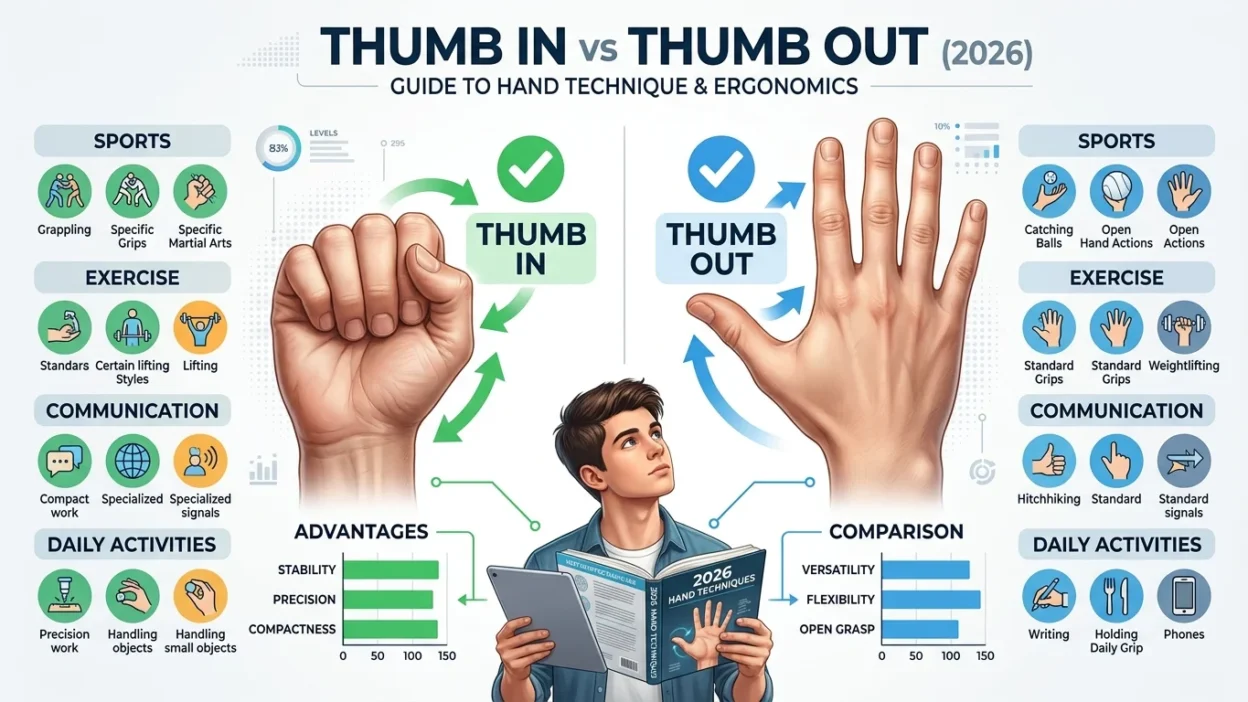
Learning thumb in vs thumb out becomes easier when you understand context, hand positioning, communication habits, and usage differences clearly. Many learners, writers, and content creators feel confused when they search this keyword in daily English. People often ask questions about which form is correct to use in conversation, writing, emails, and social posts. Many users are unsure of the exact meaning, especially in different situations involving hand position, physical action, or keeping balance. From my experience, understanding the full context is the fastest way to quickly understand the intended meaning.
Sometimes the expression functions as a simple phrase, while in other cases it behaves like a fixed phrase. The choice often changes depending on the situation, which can create mistakes in formal writing and written instructions. This flexibility leads to confusion, especially when people follow guidance that lacks clear instructions. In a less strict way, usage may also depend on personal habits and communication styles.
In real life, people may describe a thumb position differently, creating doubt about proper usage. A practical guide can help people improve communication and avoid confusion when discussing thumb placement. Because the topic appears in many situations, learning the difference remains important for clear understanding.
Quick Answer
| Question | Answer |
| Is “thumb in” correct? | Yes |
| Is “thumb out” correct? | Yes |
| Do they mean the same thing? | No |
| What does thumb in mean? | Thumb points inward |
| What does thumb out mean? | Thumb points outward |
| Is one always better? | No |
| Does context matter? | Yes |
| Should you follow instructions carefully? | Yes |
Easy Rule
| If the thumb points… | Use |
| Toward the body or inside | Thumb In |
| Away from the body or outside | Thumb Out |
Simple Background Explanation
The words themselves are very simple.
| Word | Meaning |
| Thumb | The short thick finger on your hand |
| In | Inside or toward something |
| Out | Outside or away from something |
When combined, the phrases describe the position of the thumb.
People use these expressions in many activities:
| Activity | Possible Use |
| Sports | Hand positioning |
| Exercise | Body alignment |
| Dance | Arm movements |
| Driving | Hand signals |
| Workplace training | Safety instructions |
| Daily conversations | Describing hand placement |
Because different activities use different positions, confusion can happen.
What Does Thumb In Mean?
Thumb in means the thumb is turned inward, tucked inward, or pointing toward the body or another object.
Examples
| Situation | Meaning |
| Thumb tucked into a fist | Thumb in |
| Thumb pointing toward the body | Thumb in |
| Thumb folded against the hand | Thumb in |
| Thumb moved inward during an exercise | Thumb in |
Example Sentences
- Keep your thumb in while making a fist.
- The instructor asked everyone to hold their thumb in.
- He practiced the movement with his thumb in.
- The safety guide recommended keeping the thumb in.
What Does Thumb Out Mean?
Thumb out means the thumb points away from the hand, away from the body, or outward.
Examples
| Situation | Meaning |
| Thumbs-up gesture | Thumb out |
| Thumb extended away from fingers | Thumb out |
| Thumb pointing outward | Thumb out |
| Hand opened with thumb extended | Thumb out |
Example Sentences
- Hold your thumb out during the stretch.
- The coach asked players to keep their thumb out.
- She gave a thumbs-up with her thumb out.
- The guide showed the correct position with the thumb out.
The Main Difference
| Feature | Thumb In | Thumb Out |
| Direction | Inward | Outward |
| Position | Closer to hand or body | Away from hand or body |
| Common Use | Fists, grips, safety | Signals, gestures, stretching |
| Movement | Toward center | Away from center |
| Visual Appearance | Tucked | Extended |
| Often Used For | Control and protection | Visibility and signaling |
The key difference is direction.
Comparison Table
| Feature | Thumb In | Thumb Out |
| Expression Type | Position description | Position description |
| Refers To | Inward thumb placement | Outward thumb placement |
| Used In Sports | Yes | Yes |
| Used In Exercise | Yes | Yes |
| Used In Dance | Yes | Yes |
| Used In Safety Training | Often | Sometimes |
| Used In Hand Signals | Rarely | Often |
| Indicates Protection | Often | Less often |
| Indicates Openness | Rarely | Often |
| Depends On Context | Yes | Yes |
| Always Correct? | No | No |
| Context Required? | Yes | Yes |
Which One Should You Use and When?
Use the phrase that matches the actual position of the thumb.
Use Thumb In When:
| Situation | Example |
| Making a fist | Keep your thumb in. |
| Following safety instructions | Keep your thumb in while gripping the tool. |
| Certain exercises | Move with your thumb in. |
| Protective hand positions | Hold your thumb in. |
Use Thumb Out When:
| Situation | Example |
| Giving a thumbs-up | Keep your thumb out. |
| Following stretching instructions | Extend your thumb out. |
| Signaling approval | Put your thumb out. |
| Showing hand position clearly | Hold the thumb out. |
Common Mistakes People Make
1: Thinking One Is Always Correct
❌ Thumb in is always right.
✅ Both expressions are correct depending on the situation.
2: Ignoring Context
| Incorrect Approach | Better Approach |
| Using the same phrase everywhere | Match the actual hand position |
| Guessing the meaning | Look at the context |
3: Following Instructions Too Quickly
| Problem | Solution |
| Misunderstanding hand position | Read instructions carefully |
| Wrong movement | Watch examples if available |
4: Assuming They Mean the Same Thing
| Incorrect Idea | Correct Information |
| Thumb in = Thumb out | They describe different positions |
Everyday Real-Life Examples
In Emails
| Example |
| Please perform the exercise with your thumb in. |
| The guide recommends keeping the thumb out during the stretch. |
In News Reports
| Example |
| The athlete demonstrated the technique with the thumb in. |
| Trainers explained when to keep the thumb out. |
On Social Media
| Example |
| Try this exercise with your thumb in. |
| Remember to keep your thumb out during the movement. |
At School
| Example |
| The teacher demonstrated a thumb in grip. |
| Students practiced the thumb out position. |
During Sports
| Example |
| The coach instructed players to keep their thumb in while holding the bat. |
| The trainer demonstrated a thumb out position during warmups. |
Learning Section for Students and Beginners
A simple memory trick can help.
| Phrase | Memory Tip |
| Thumb In | In = Inside |
| Thumb Out | Out = Outside |
Quick Practice
| Sentence | Answer |
| Keep your thumb _____ while making a fist. | In |
| Give a thumbs-up with your thumb _____. | Out |
| The safety guide says keep the thumb _____. | In |
| Extend the thumb _____ during the stretch. | Out |
FAQs
1. Is thumb in correct English?
Yes. It is commonly used when describing hand position.
2. Is thumb out correct English?
Yes. It is also commonly used when describing hand position.
3. Do thumb in and thumb out mean the same thing?
No. They describe opposite positions.
4. Which one should I use?
Use the phrase that matches the actual direction of the thumb.
5. Are these grammar terms?
No. They are position descriptions.
6. Can both be used in sports?
Yes. Different sports and techniques may require different thumb positions.
7. Can both be used in exercise instructions?
Yes. Exercise guides often use both expressions.
8. Why do people get confused?
Because both expressions are correct, and the correct choice depends on context.
Conclusion
Understanding thumb in vs thumb out is much easier when you focus on the position of the thumb. Both expressions are correct, but they describe different directions. Thumb in means the thumb moves inward or stays close to the hand, while thumb out means the thumb extends outward or away from the hand.
Whenever you see these phrases, pay attention to the activity, movement, or instruction being described. Context is the key. Once you learn this simple rule, choosing the correct expression becomes easy and natural. Whether you are reading instructions, following exercises, learning sports techniques, or improving your English, understanding these two phrases will help you communicate more clearly.