When we describe objects or everyday items, simple words sometimes feel boring. For example, saying “the glass was clear” is fine, but saying “the glass was as clear as crystal” creates a stronger picture in the reader’s mind. This is where similes become very useful.
In simple terms, a simile is a comparison between two different things using the words “like” or “as.” Writers use similes to make descriptions more colorful and interesting. Instead of plain sentences, similes help readers imagine what something looks, feels, or sounds like.
Understanding the meaning of similes can greatly improve your writing. Whether you are describing objects, places, or feelings, similes help add creativity and emotion. That’s why many stories, poems, and essays use creative writing similes.
In this guide, we’ll explore similes for things, see many examples of similes, and learn how to use similes in writing. You’ll also find simple simile sentences and a short exercise to test your understanding.
So let’s explore some fun and creative comparisons that writers use to describe everyday things.
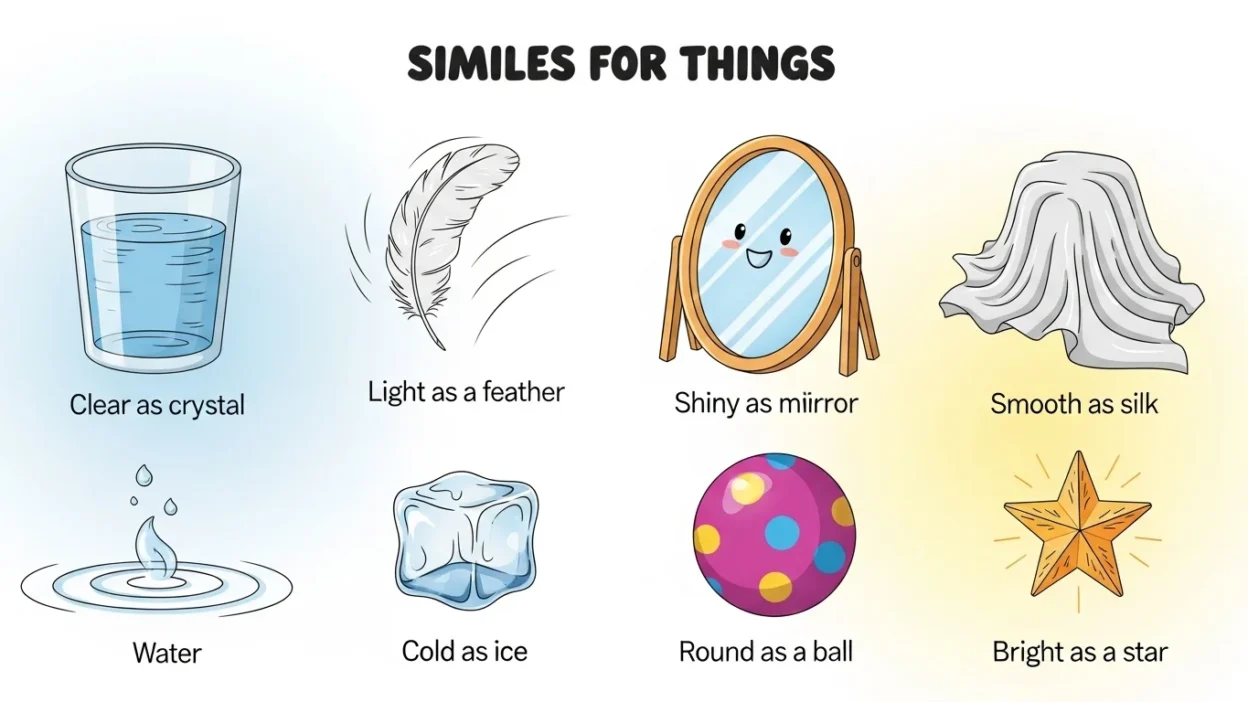
1. As clear as crystal
Meaning: Very clear or easy to see.
Explanation: Crystal is known for its transparency.
Examples:
- The water was as clear as crystal.
- Her explanation was as clear as crystal.
2. As light as a feather
Meaning: Extremely light.
Explanation: Feathers weigh almost nothing.
Examples:
- The box felt as light as a feather.
- The scarf was as light as a feather.
3. As hard as rock
Meaning: Very solid or tough.
Explanation: Rocks are strong and hard to break.
Examples:
- The ground was as hard as rock.
- The table felt as hard as rock.
4. Like a mirror in the sun
Meaning: Very shiny or reflective.
Explanation: Mirrors reflect light strongly.
Examples:
- The lake shone like a mirror in the sun.
- The car sparkled like a mirror in the sun.
5. As smooth as silk
Meaning: Very soft and smooth.
Explanation: Silk fabric is famous for its softness.
Examples:
- The fabric felt as smooth as silk.
- The surface was as smooth as silk.
6. Like a sponge soaking water
Meaning: Absorbing something quickly.
Explanation: Sponges soak up liquids fast.
Examples:
- The towel worked like a sponge soaking water.
- The soil acted like a sponge soaking water.
7. As sharp as a knife
Meaning: Very sharp or precise.
Explanation: Knives cut easily.
Examples:
- The blade was as sharp as a knife.
- The edge felt as sharp as a knife.
8. Like a balloon floating in air
Meaning: Light and floating.
Explanation: Balloons drift easily in the air.
Examples:
- The bag moved like a balloon floating in air.
- The toy floated like a balloon floating in air.
9. As bright as a star
Meaning: Very bright.
Explanation: Stars shine brightly in the night sky.
Examples:
- The light was as bright as a star.
- The lamp shone as bright as a star.
10. Like a rock at the bottom of a river
Meaning: Very stable or unmoving.
Explanation: Rocks underwater rarely move.
Examples:
- The statue stood like a rock at the bottom of a river.
- The chair stayed like a rock at the bottom of a river.
11. As thin as paper
Meaning: Extremely thin.
Explanation: Paper is light and thin.
Examples:
- The sheet was as thin as paper.
- The crust felt as thin as paper.
12. Like a magnet pulling metal
Meaning: Strong attraction.
Explanation: Magnets naturally attract metal.
Examples:
- The device worked like a magnet pulling metal.
- The force felt like a magnet pulling metal.
13. As cold as ice
Meaning: Extremely cold.
Explanation: Ice is freezing cold.
Examples:
- The drink was as cold as ice.
- The metal felt as cold as ice.
14. Like a clock ticking steadily
Meaning: Working regularly.
Explanation: Clocks move at a steady pace.
Examples:
- The machine ran like a clock ticking steadily.
- The engine worked like a clock ticking steadily.
15. As heavy as a mountain
Meaning: Extremely heavy.
Explanation: Mountains symbolize great weight.
Examples:
- The box felt as heavy as a mountain.
- The bag seemed as heavy as a mountain.
16. Like glass ready to shatter
Meaning: Very fragile.
Explanation: Glass breaks easily.
Examples:
- The ornament looked like glass ready to shatter.
- The item felt like glass ready to shatter.
17. As round as a ball
Meaning: Perfectly circular.
Explanation: Balls have a round shape.
Examples:
- The fruit was as round as a ball.
- The bubble looked as round as a ball.
18. Like a bridge connecting two sides
Meaning: Joining things together.
Explanation: Bridges connect separate places.
Examples:
- The cable worked like a bridge connecting two sides.
- The design acted like a bridge connecting two sides.
19. As bright as lightning
Meaning: Extremely bright.
Explanation: Lightning flashes very brightly.
Examples:
- The flash was as bright as lightning.
- The screen shone as bright as lightning.
20. Like a wall blocking the way
Meaning: Preventing movement.
Explanation: Walls stop people from passing.
Examples:
- The barrier stood like a wall blocking the way.
- The object acted like a wall blocking the way.
Practical Exercise
Questions
- The water was as clear as ______.
- The feather felt as light as a ______.
- The blade was as sharp as a ______.
- The drink was as cold as ______.
- The box felt as heavy as a ______.
- The surface felt as smooth as ______.
- The ornament looked like glass ready to ______.
- The fruit was as round as a ______.
- The lamp shone as bright as a ______.
- The machine worked like a ______ ticking steadily.
Answers with Explanation
- crystal – Crystal represents clarity.
- feather – Feathers are very light.
- knife – Knives symbolize sharpness.
- ice – Ice represents extreme cold.
- mountain – Mountains symbolize heavy weight.
- silk – Silk is smooth and soft.
- shatter – Glass breaks easily.
- ball – Balls are perfectly round.
- star – Stars shine brightly.
- clock – Clocks tick steadily.
Conclusion
Similes are simple but powerful tools that make writing more interesting. By comparing one thing to another using “like” or “as,” writers can create strong and clear images.
For example, saying something is “as light as a feather” or “as smooth as silk” helps readers imagine the object easily. These examples of similes make descriptions vivid and engaging.
Now that you understand the meaning of similes and have seen many simile sentences, try creating your own. Think about everyday objects around you and compare them to something familiar.With practice, you’ll quickly learn how to use similes in writing and make your creative writing more exciting.