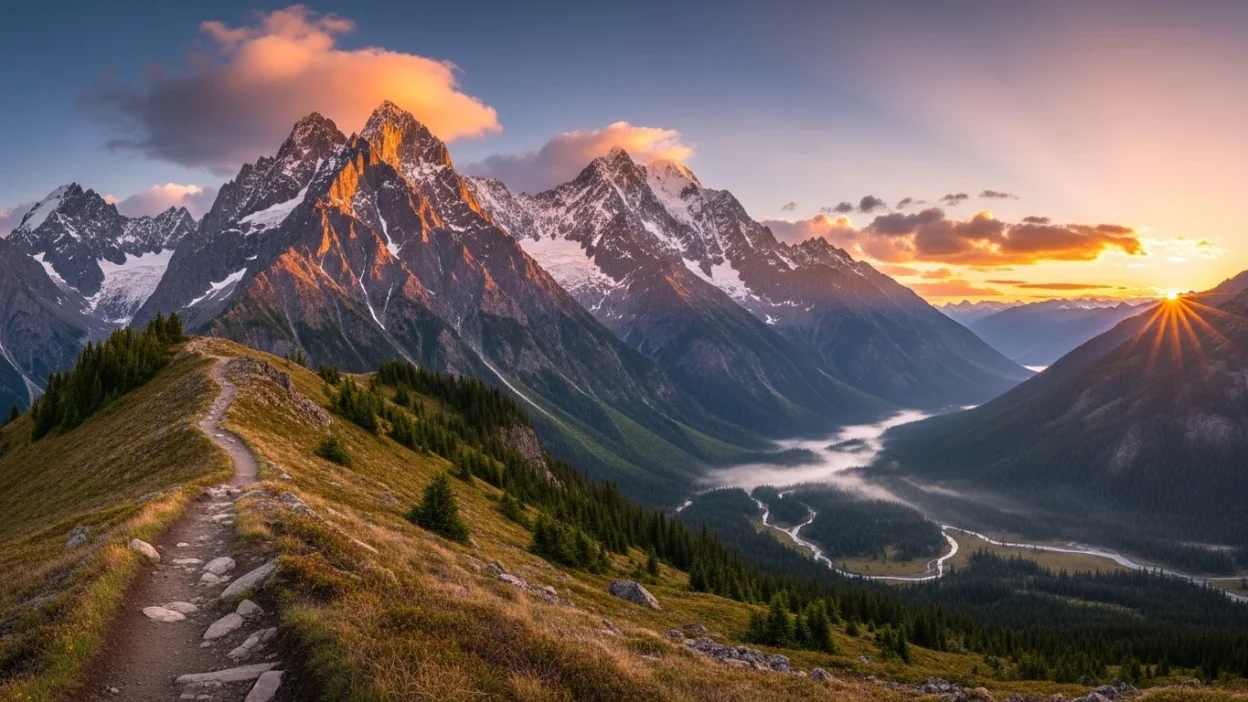
Mountains are big. They are strong. They are quiet. But if you are a writer, you don’t just say, “The mountain is big.” You describe it in a way that makes people see it. That’s where similes come in.
In simple terms, a simile is a comparison between two different things using the words “like” or “as.” For example, you might say, “The mountain stood like a giant.” Now the reader can clearly imagine its size and power.
The meaning of similes is easy. They help you compare things to make your writing more vivid. In creative writing, similes add beauty and emotion. They turn plain sentences into powerful pictures.
If you want to improve your simile sentences and understand how to use similes in writing, you are in the right place. Let’s explore 36 beautiful examples of similes for mountains and see how they work in context.
1. The mountain stood like a giant.
Meaning: The mountain is very tall and powerful.
What it conveys: Strength and size.
Examples:
- The mountain stood like a giant over the village.
- The cliff rose like a giant from the sea.
2. The peaks were as sharp as knives.
Meaning: The tops are pointed and steep.
What it conveys: Danger and sharpness.
Examples:
- The peaks were as sharp as knives in the sunlight.
- The rocks looked as sharp as blades.
3. The mountain rose like a wall.
Meaning: It looked tall and solid.
What it conveys: Strength and barrier.
Examples:
- The mountain rose like a wall before us.
- The hills stood like walls around the town.
4. The snow lay like a white blanket.
Meaning: Snow covered the mountain fully.
What it conveys: Softness and peace.
Examples:
- Snow lay like a white blanket on the mountain.
- Frost spread like a blanket over the field.
5. The mountain stood as still as a statue.
Meaning: It did not move.
What it conveys: Calmness and silence.
Examples:
- The mountain stood as still as a statue at sunrise.
- The rocks were as still as statues.
6. The rocks were as hard as iron.
Meaning: The rocks are very solid.
What it conveys: Toughness.
Examples:
- The stones felt as hard as iron.
- His will was as hard as iron.
7. The mountain towered like a king.
Meaning: It looked proud and powerful.
What it conveys: Authority.
Examples:
- The mountain towered like a king over the land.
- The tallest peak ruled like a king.
8. The path twisted like a snake.
Meaning: The road curved sharply.
What it conveys: Movement and shape.
Examples:
- The trail twisted like a snake up the hill.
- The river moved like a snake through the valley.
9. The cliffs dropped like a falling curtain.
Meaning: The drop was sudden and steep.
What it conveys: Drama.
Examples:
- The cliffs fell like a curtain into the sea.
- The rocks dropped like curtains at the edge.
10. The mountain glowed like gold at sunset.
Meaning: It shined in warm light.
What it conveys: Beauty.
Examples:
- The peak glowed like gold in the evening.
- The clouds shone like gold at sunset.
11. The wind howled like a wolf.
Meaning: The wind made a loud sound.
What it conveys: Wildness.
Examples:
- The wind howled like a wolf across the mountain.
- The storm cried like a wild animal.
12. The mountain stretched like a sleeping giant.
Meaning: It looked huge and long.
What it conveys: Massive size.
Examples:
- The mountain stretched like a sleeping giant.
- The hills lay like giants under the sky.
13. The valley rested like a peaceful dream.
Meaning: The valley looked calm.
What it conveys: Quiet beauty.
Examples:
- The valley rested like a peaceful dream.
- The meadow looked like a soft dream.
14. The summit shone like a silver crown.
Meaning: The top looked bright and royal.
What it conveys: Glory.
Examples:
- The summit shone like a silver crown.
- The snow sparkled like a royal crown.
15. The mountain stood firm like a soldier.
Meaning: It looked strong and brave.
What it conveys: Courage.
Examples:
- The mountain stood firm like a soldier.
- He stood firm like a soldier in battle.
16. The shadows moved like dark waves.
Meaning: The shadows shifted slowly.
What it conveys: Mystery.
Examples:
- Shadows moved like dark waves across the slopes.
- Clouds rolled like waves in the sky.
17. The ridge curved like a bow.
Meaning: The shape was bent.
What it conveys: Shape and form.
Examples:
- The ridge curved like a bow against the sky.
- The branch bent like a bow.
18. The mountain rose as high as the clouds.
Meaning: It reached great height.
What it conveys: Height and greatness.
Examples:
- The mountain rose as high as the clouds.
- The tower climbed as high as the sky.
19. The rocks lay scattered like broken glass.
Meaning: Rocks were spread around.
What it conveys: Sharpness and disorder.
Examples:
- Rocks lay like broken glass on the path.
- Leaves scattered like glass pieces.
20. The mountain stood like a silent guardian.
Meaning: It seemed to protect the land.
What it conveys: Protection and watchfulness.
Examples:
- The mountain stood like a silent guardian over the town.
- The trees guarded the lake like silent protectors.
Practical Exercise
Questions
- Complete: The mountain stood like a _______.
- Is this a simile? “The mountain is a giant.”
- Complete: The snow lay like a _______.
- Identify the comparison: “The wind howled like a wolf.”
- Write your own simile about mountains.
- Is this a simile? “The peak is tall.”
- Complete: The path twisted like a _______.
- What words usually show a simile?
- Complete: The summit shone like a _______.
- Find the simile: “The rocks were as hard as iron.”
Answers with Explanation
- Giant (shows size and strength).
- No. That is a metaphor.
- White blanket (shows full covering).
- Wind is compared to a wolf.
- Example: The mountain stood as proud as a king.
- No. No comparison word used.
- Snake (shows curve).
- “Like” and “as.”
- Silver crown (shows shine and glory).
- “As hard as iron” is the simile.
Conclusion
Now you understand the meaning of similes and how they make writing stronger. Similes help readers see the height, feel the strength, and imagine the beauty of mountains.
For example, instead of saying “The mountain was tall,” you might say, “The mountain stood like a giant.” That small change makes your writing powerful.
Keep practicing creative writing similes. Look at nature. Compare shapes, sounds, and feelings. The more you practice, the better your simile sentences will become.
Start today. Write three of your own similes for mountains!